

The team behind your dispatch desk
PickPackFlow was built by people who spent years packing their own orders — and who know exactly which parts of fulfilment quietly break as a brand grows.
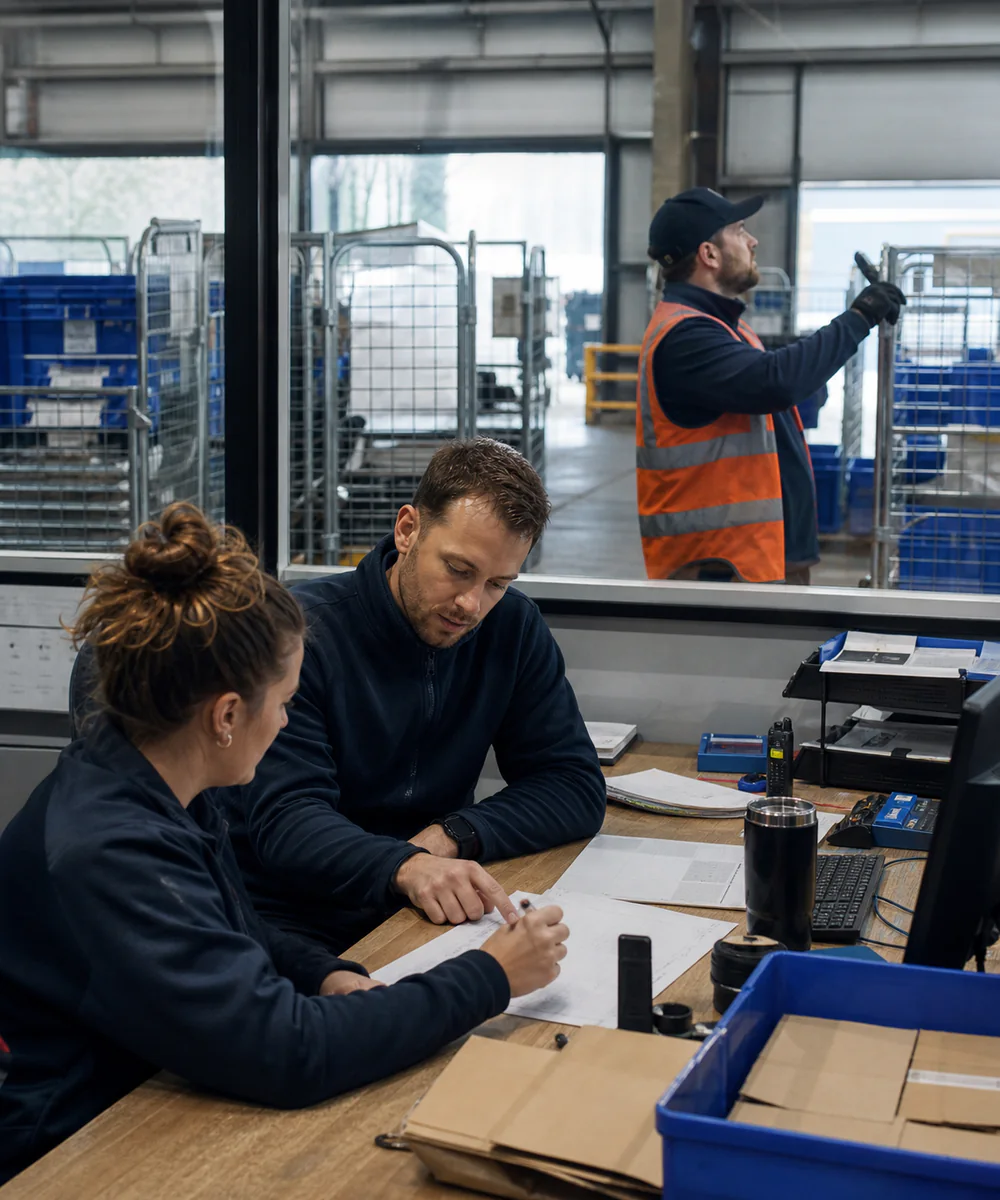
We started on the wrong side of the packing table
PickPackFlow exists because of a specific, familiar problem: a growing brand hits the point where fulfilment stops scaling. Orders are still going out, but only because someone is staying late to make it happen. Stock counts drift. A courier misses a collection and the support inbox fills up.
The obvious answer is to outsource. The difficulty is that the experience of outsourcing is wildly inconsistent — some providers are genuinely more disciplined than the operation you are leaving, and some are considerably less. The second kind is expensive in ways that do not show up on the invoice.
We built PickPackFlow to be the first kind. That meant deciding early that we would barcode everything, scan at every touch, publish our accuracy figures to clients, and give every account a named person rather than a shared inbox. It is a slower way to grow a 3PL. It is a much better way to keep the clients you win.
Today we handle fulfilment, warehousing, packaging, marketplace prep and freight for brands selling across their own storefronts, marketplaces and into retail — with the same standards applied whether a client ships fifty orders a month or twenty thousand.
- Same-day cut-off
- 21:00Same-day cut-off
- Live integrations
- 17Live integrations
- Services in-house
- 6Services in-house
- Quote turnaround
- 1 dayQuote turnaround
Four commitments we run the floor on
These are not posters in the break room. Each one maps to something we actually do, and something you can hold us to.
Measure it or do not claim it
Accuracy, dispatch performance and put-away times are recorded and reported monthly. If a figure slips, you see it from us before you see it in your support inbox.
No surprises on the invoice
Our rates are published — per order, per extra unit, and per cubic foot or pallet of storage. Anything outside them is agreed before work begins, because we would rather have an awkward conversation early than a disputed invoice later.
A person, not a queue
Every client gets a named account manager who knows the catalogue and the seasonality. Escalation is a phone call, not a form.
Solve it at the source
A recurring mispick is a process problem, not a people problem. We fix the layout, the label or the rule rather than asking the team to concentrate harder.
The operating principles behind the numbers
A 3PL is a series of small disciplines repeated thousands of times a day. These are the ones that decide whether the numbers hold.
- 01
Everything has a fixed home
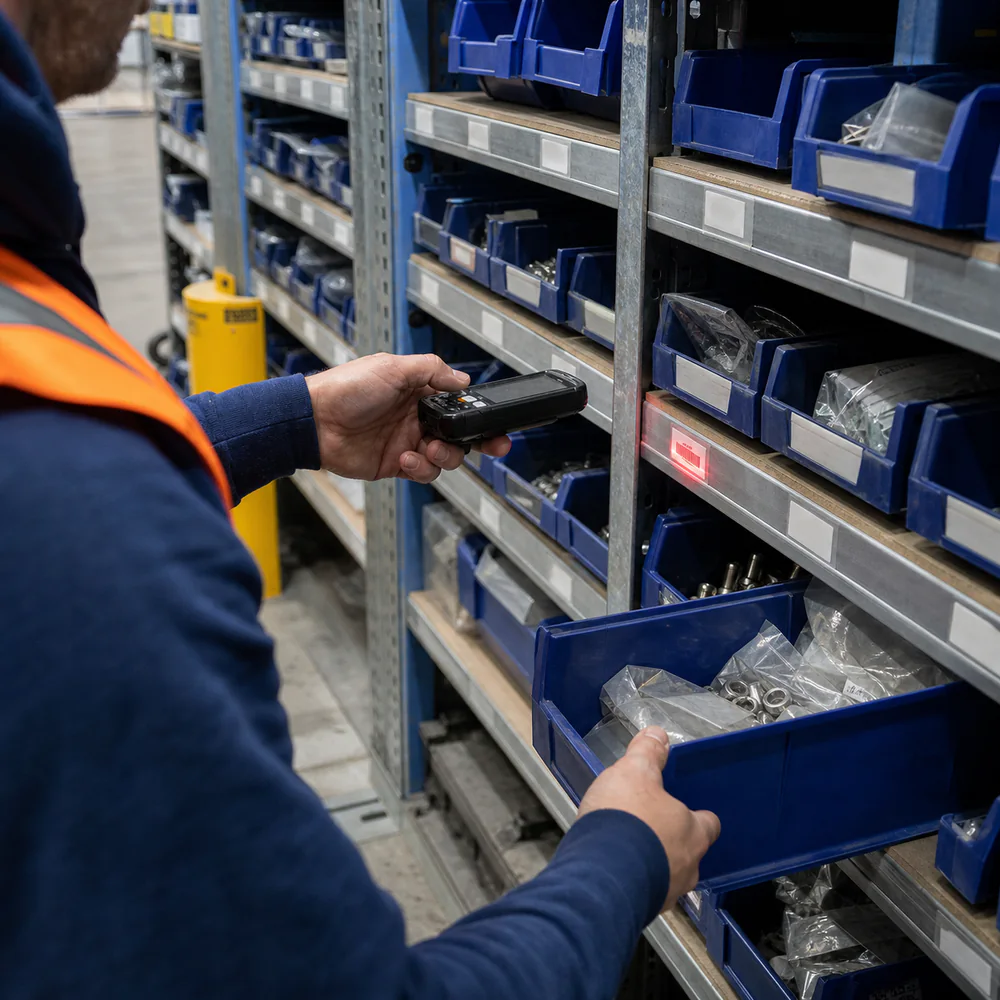
Every SKU is assigned a location based on size, weight and how fast it moves. Nothing is stored wherever there happened to be a gap, which is what shortens pick routes and keeps counts accurate.
- 02
The scan is not optional
Location and item are scanned at pick, and the order is verified at pack. A mismatch stops the bench before a label prints. It is the single control that holds accuracy together at volume.
- 03
Specifications are written down
Packing standards are documented and photographed per basket type. New and seasonal staff are trained against the document, which is why the hundredth parcel of the day matches the first.
- 04
Exceptions are surfaced daily
Short stock, failed integrations, damaged inbound and held orders go into a daily exception report. Problems reach you while there is still time to make a decision about them.
- 05
Counting never stops
Cycle counts run continuously against a rolling schedule weighted by velocity, instead of one annual shutdown that corrects a year of drift in a weekend.
- 06
Peak is planned in summer
Capacity, staffing and carrier allocation for Q4 are agreed months ahead with each client, based on their forecast rather than last year's average.
The short version
Fixed locations, mandatory scans, written specifications and daily exception reporting. Unremarkable individually — together they are the whole difference.
Where your stock actually sits
Our hubs are alarmed, CCTV-monitored and covered by goods-in-trust insurance. Racking is a mix of standard pallet positions, shelf and bin storage for small fast-moving lines, bulk floor space for oversized stock, and secure caged areas for high-value goods.
Layout is deliberate rather than incidental. Fast movers sit closest to the packing benches, replenishment runs from bulk to pick face automatically, and dispatch lanes are separated by carrier so collections do not queue behind each other.
Walk through the facility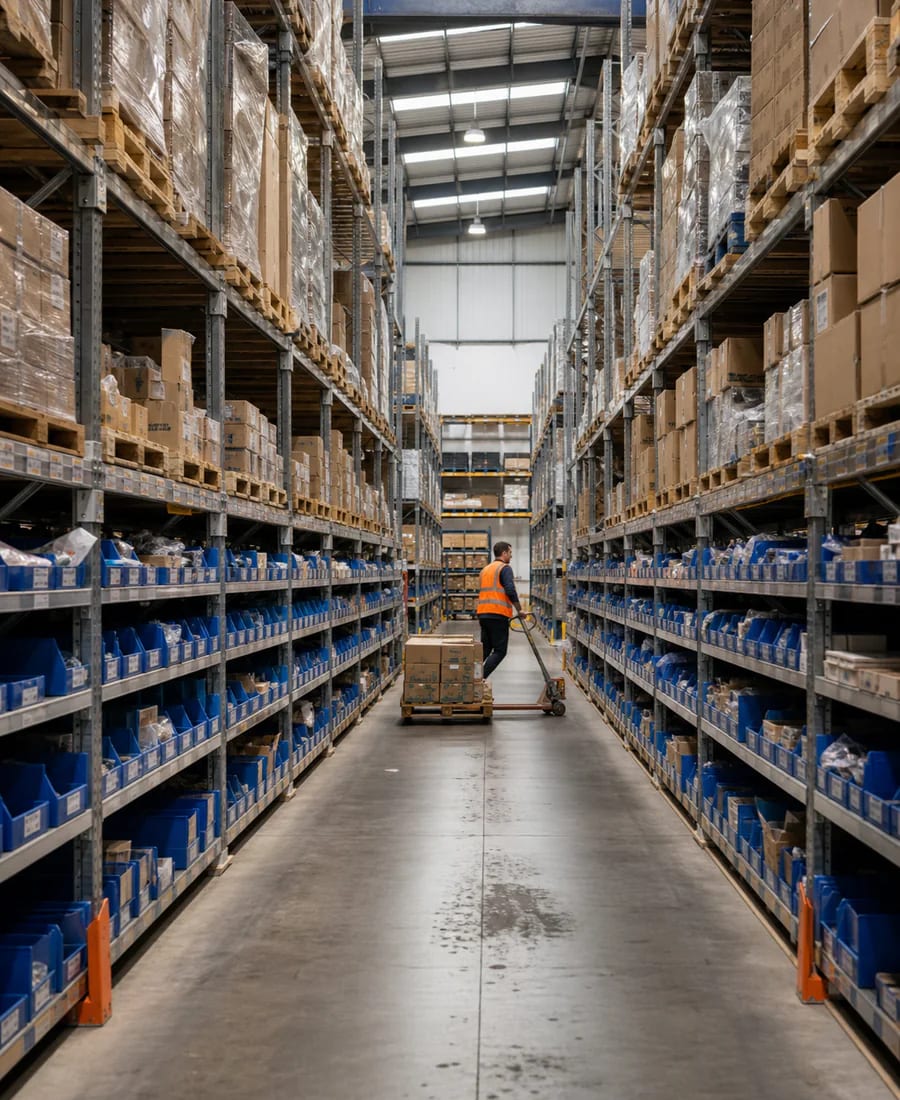
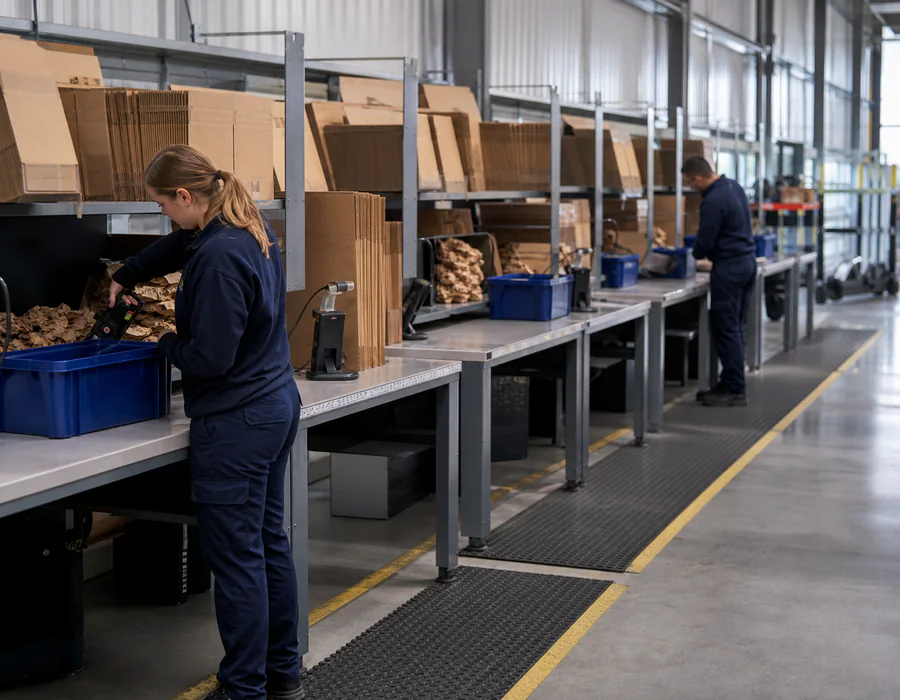

Come and see the floor mid-shift.
The best way to judge a fulfilment operation is to watch it working on an ordinary Tuesday. Book a visit and ask us the awkward questions.